Usually, yes, if your organization paid an independent referee directly and the total reached $2,000 for 2026. That's the new Form 1099-NEC threshold for payments made in 2026, up from $600. The form goes to the official and to the IRS by January 31, which moves to February 1, 2027 this cycle because January 31 is a Sunday. Nonprofit leagues and government agencies are covered too. Payments made through Venmo, PayPal or a card processor are reported by the payment company on a 1099-K instead. If a booking service pays the officials, your league isn't the one paying them.
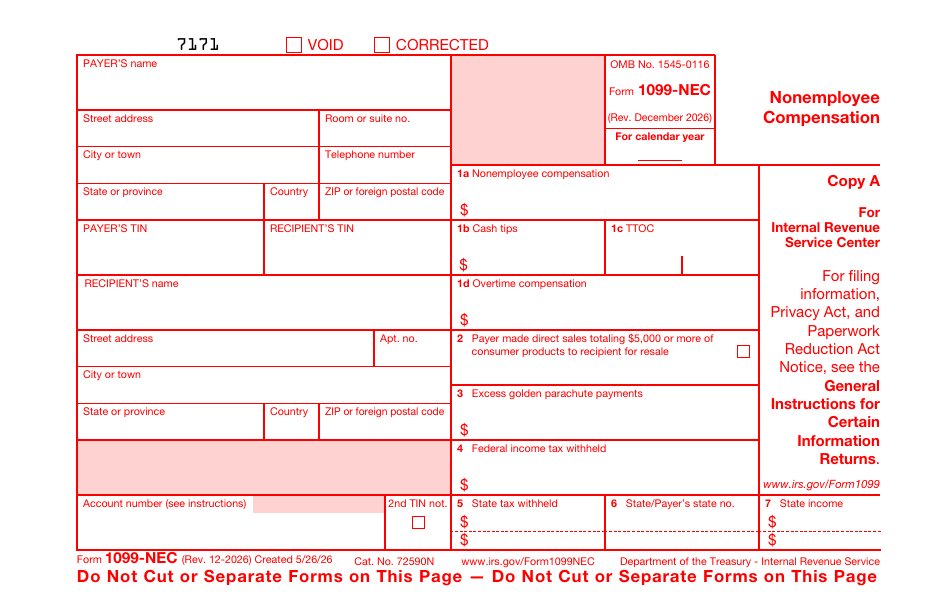
This page is for the people who end up holding the paperwork: league treasurers, tournament directors, athletic directors, CYO and PAL coordinators, and parks and recreation staff on Long Island who paid referees, umpires or table officials themselves this year. It's general information drawn from IRS instructions, not tax advice. Your accountant gets the final word on your organization's situation.
What changed for 2026: the $2,000 threshold
For years the number everyone remembered was $600. If you paid a non-employee $600 or more for services in a year, you sent a 1099. That changed with the 2025 federal tax law (Public Law 119-21). The IRS now states the rule plainly: for payments made before 2026 the reporting threshold is $600, and for payments made in 2026 it's $2,000. Starting in 2027, the IRS says it will adjust that amount for inflation each year.
For a referee budget, the jump matters. An official paid per game used to cross $600 within a busy season. At $2,000 it takes more than three times as much work for the same person. Many part-time officials who work a handful of your games will now fall under the line, while your regulars, the ones who work most Saturdays from September through November, may still cross it.
Two details trip people up:
- It's per person, per calendar year, across everything you paid them. Add the fall season, a winter clinic and the Memorial Day tournament together. Don't count by season or by event.
- Backup withholding has no threshold. If you withheld federal income tax from an official because they didn't give you a taxpayer ID number, the IRS says you file a 1099-NEC for them regardless of the amount.
Does this apply to nonprofits, schools and towns?
The answer from the IRS instructions is yes. The 1099 rules apply to payments made "in the course of your trade or business." That sounds like it leaves volunteer-run leagues out. It doesn't. The instructions say that nonprofit organizations are considered to be engaged in a trade or business and are subject to these reporting requirements, and that payments by federal, state or local government agencies are reportable too.
On Long Island that covers most of the organizations that hire officials directly:
| Who paid the official | Generally covered by 1099-NEC rules? |
|---|---|
| 501(c)(3) youth league or travel club | Yes. Nonprofits are treated as engaged in a trade or business |
| School district or BOCES program | Yes. Government-agency payments are reportable |
| Town or village parks and recreation department | Yes, same as above |
| For-profit tournament company or indoor facility | Yes |
| Parent paying a ref for a backyard birthday game | Generally no. Personal payments aren't reportable |
The last row is the real exception. A family that hires a referee for a birthday party game is making a personal payment, not a business one.
Is your referee an independent contractor or an employee?
A 1099-NEC is for people who aren't your employees. Most per-game officials work as independent contractors: they pick which games to accept, work for several leagues, bring their own uniform and gear, and follow the rule book rather than your instructions on how to officiate. But classification depends on the facts, and the IRS looks at behavioral control, financial control and the relationship between the parties. If your organization schedules the same official every day and directs how they do the job, talk to your accountant before assuming contractor status. If someone is an employee, the paperwork is a W-2, not a 1099.
We go through the practical trade-offs in agency vs. independent contractor referees.
Venmo, Zelle, cash and checks: which payments count
How you paid changes who reports it.
- Cash, check, or a direct bank transfer from the league. These count toward your 1099-NEC total for that official.
- Credit card, payment card or a third-party payment network. The IRS instructions say payments made this way are reported on Form 1099-K by the payment settlement entity and aren't subject to 1099-NEC reporting by you. That generally covers payments sent through PayPal or a business Venmo account.
- Zelle. Zelle moves money directly between bank accounts. Ask your accountant how to treat it. Don't assume it works like a card network.
The practical step is to record the payment method for every official, every game. If your treasurer paid half the season in cash and half through a payment app, those halves are treated differently. Our referee payment methods guide covers the day-of options and their trade-offs.
Rather not chase W-9s next season?
Book Long Island referees through one request and pay on one invoice. Same-week and same-day requests welcome.
Request a referee →The paperwork, step by step
1. Collect a Form W-9 before the first payment
Form W-9 is how an official gives you their legal name, address and taxpayer ID number (an SSN or EIN). The easiest time to get it is before the first game, when the official wants to get paid. In January, after the season, a lot of them don't answer the email. If an official won't give you a TIN, backup withholding rules can apply, and your accountant can walk you through them.
2. Keep a running total per official
A simple spreadsheet works: date, game or event, amount, payment method. At the end of the year, filter for payments by cash, check or bank transfer and total them per person. Anyone at $2,000 or more for 2026 gets a 1099-NEC.
3. File and furnish by the deadline
Form 1099-NEC has the same deadline for the IRS copy and the official's copy: January 31. The IRS instructions say that when the due date falls on a Saturday, Sunday or legal holiday, it moves to the next business day. January 31, 2027 is a Sunday, so 1099-NECs for 2026 payments are due Monday, February 1, 2027.
4. Check whether you have to e-file
Since 2024, if your organization files 10 or more information returns in total (all types added together, not only 1099-NECs), the IRS requires them to be filed electronically. A league with a dozen regular officials crosses that line easily. The IRS offers a free online filing portal, the Information Returns Intake System (IRIS).
5. Don't forget New York
State reporting rules are separate from federal ones, and they change. Ask your accountant whether your organization has any New York State filing obligation for the payments you're reporting.
A year-end checklist for Long Island league treasurers
- Pull every referee, umpire, scorekeeper and timekeeper payment for calendar year 2026.
- Mark how each payment was made: cash, check, bank transfer, payment app or card.
- Total the cash, check and bank-transfer payments per official.
- List everyone at $2,000 or more, plus anyone you withheld tax from.
- Confirm you have a current W-9 for each person on that list. Request any missing ones now, not in late January.
- Count all the information returns your organization will file. At 10 or more, plan to e-file.
- File and furnish by February 1, 2027.
- For 2027, set up W-9 collection before opening day and ask whether the inflation-adjusted threshold has been published.
How booking through a service changes the picture
Most of the work above comes from paying many individual officials directly. When a league books through an assigning or staffing service, the league usually pays one invoice to the service, and the service pays the officials. Those officials are then paid by the service, not by your league, so they aren't on your list of people you paid.
That doesn't make the question go away entirely. Your payment to the service is a business payment too, and whether it needs its own 1099 depends on how the service is organized (for example, payments to most corporations aren't reported on 1099-NEC). Ask the service how it's set up and ask your accountant how to treat it. And ask any service, including us, to confirm in writing how officials are paid and who handles their year-end tax forms. A service that can't answer that clearly isn't taking the paperwork off your plate.
For the broader comparison of booking direct versus through a service, see our referee assigning service guide. For budgeting, what youth sports referees cost on Long Island covers the line items.
What this page won't tell you
We're a referee booking service, not tax preparers. We haven't covered penalties, corrections, payments to officials who live outside the U.S., or whether a specific person in your league is an employee. Those depend on your facts. Use the IRS sources listed at the bottom of this page and your accountant for those calls.
Need officials for a game this week?
Tell us the sport, date, field and crew size. We call back to confirm details and quote.
Request a referee →Frequently asked questions
If the league pays an independent official directly and the total paid to that person in 2026 reaches $2,000, the IRS generally expects a Form 1099-NEC. IRS instructions say nonprofit organizations are treated as engaged in a trade or business for these rules, so a 501(c)(3) league isn't exempt just because it's a nonprofit. Payments by government agencies, such as a school district or town parks department, are also reportable.
$2,000. For payments made in calendar year 2026, the IRS raised the Form 1099-NEC reporting threshold from $600 to $2,000. Payments made in 2025 stay under the old $600 rule, and the IRS says the amount will be adjusted for inflation starting in 2027.
Form 1099-NEC goes to both the official and the IRS by January 31. When that date falls on a weekend, it moves to the next business day, so 1099-NECs for 2026 payments are due February 1, 2027. If your organization files 10 or more information returns in total, the IRS requires them to be filed electronically, for example through its free IRIS portal.
IRS instructions say payments made by credit card, payment card or a third-party payment network are reported on Form 1099-K by the payment company, not on Form 1099-NEC by you. Keep records of how each official was paid. Cash, check and direct bank transfers made by the league stay on your 1099-NEC tally.
When you pay a booking service and the service pays the officials, the officials are paid by the service, not by your league. Your league's payment goes to the service on an invoice. Ask any service you use, including us, to confirm in writing how officials are paid and who handles their year-end tax forms, and ask your own tax preparer how to treat payments to the service itself.
Sources: IRS, "Am I required to file a Form 1099 or other information return?" (2026 threshold note); IRS, Instructions for Forms 1099-MISC and 1099-NEC (Rev. December 2026): $2,000 threshold for tax years after 2025, January 31 filing date under section 6071(c) and next-business-day rule, trade-or-business and nonprofit coverage, government-agency payments, Form 1099-K exception for payment card and third-party network payments, 10-return e-file threshold under T.D. 9972; IRS, Publication 1099 (2026); IRS, Form 1099-NEC and independent contractors FAQ; IRS, Form W-9. This page is general information for organizers, not tax or legal advice. Talk to your accountant about your organization's situation.