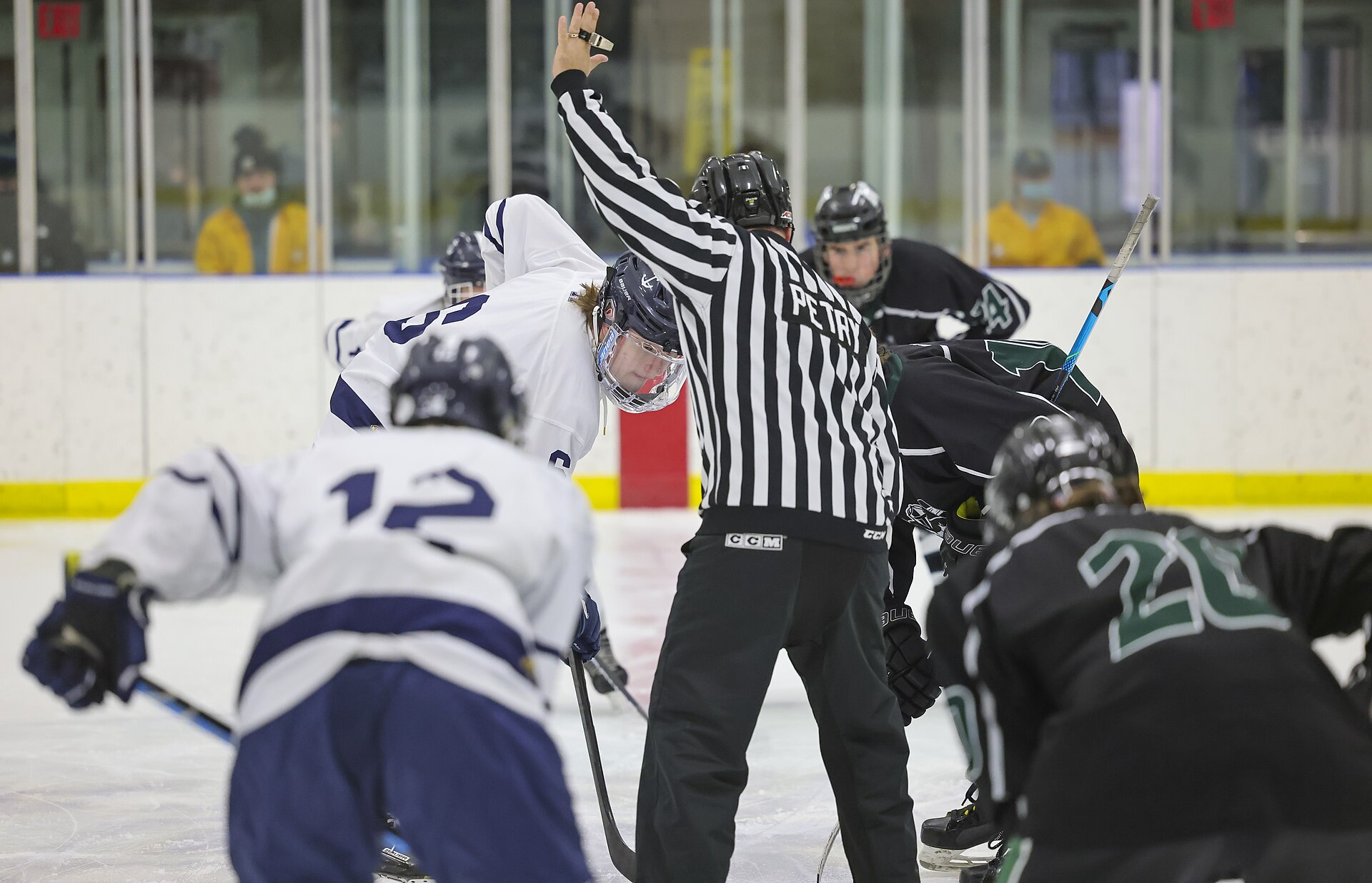
For 2026-27 the NFHS made four ice hockey rule changes. Boarding can now be called as a minor penalty, and it stays a major when an opponent is thrown violently into the boards (7-18-1). Play stops immediately if a goalkeeper's catching glove or blocker comes off (3-3-5). A new Rule 9-1-12 lets state associations allow the non-offending team to choose the faceoff location after icing or a penalty. And jerseys may carry the school's name, nickname, logo, mascot and/or the player's name (2-1-2c). The faceoff option only applies where a state adopts it, so check with your section or league before a Long Island game.
Who these changes actually reach on Long Island
Hockey on Long Island runs on two different rule books, and it matters which one your game uses. High school hockey, whether a school team or a high school club league, plays under the NFHS Ice Hockey Rules Book with state modifications layered on top. NYSPHSAA's boys ice hockey page lists its rules simply as “NFHS, updated each May,” which is why the 2026-27 changes published in late May are already in effect for this winter.
Most youth hockey, from Mites through 18U travel, and a large share of adult league play, runs under USA Hockey playing rules instead. Those are separate books with their own cycle, and none of the changes below automatically apply to them. Where the NFHS changes spread beyond school teams is in the events that borrow the book: preseason showcases, Thanksgiving and Christmas break tournaments, alumni games, and rink-run high school leagues that write “NFHS rules” on the schedule.
So the first question for any host is simple: which book are we using? Write it on your rules sheet and on your officiating request. Crews switch between NFHS and USA Hockey games in the same week, and they will work whatever you tell them. They cannot work what nobody wrote down.
The four 2026-27 changes, rule by rule
The NFHS Ice Hockey Rules Committee recommended the changes at its spring meeting in Indianapolis, and they were approved by the NFHS Rules Review Committee and Board of Directors and published on May 27, 2026. Here they are in the order a game is likely to run into them.
| Rule | What changed | Who it lands on |
|---|---|---|
| 7-18-1 | Boarding no longer requires a “violent” throw into the boards. Contact meeting the definition is a minor; a violent throw into the boards is still a major. | Referees, coaches, players, scorekeepers recording penalties |
| 3-3-5 | “Catching glove(s)” and “blocker” added to the list of goalkeeper equipment whose displacement stops play immediately. | Referees, goalies, goalie coaches |
| 9-1-12 (new) | By state association adoption, the non-offending team may select the faceoff location after an icing (9-1-11a) or a penalty infraction (9-1-11k). | State associations, league and tournament organizers, officials, coaches |
| 2-1-2c | The school's name, nickname, logo, mascot and/or the player's name are permitted on the jersey. | Athletic directors, equipment managers, uniform suppliers |
Boarding: a minor option, without softening the major
Before this season, the boarding rule described contact that caused an opponent to be thrown violently into the boards, and the penalty was a major. That left referees in an awkward spot when a check clearly met the rest of the definition but was not violent. The NFHS rationale says officials were reporting those plays as roughing or some other minor because the rule gave them no accurate option.
Dropping the word “violently” from the description fixes the reporting. Contact that checks, cross-checks, elbows, charges or trips an opponent into the boards is now a minor, and a violent throw into the boards remains a major. The NFHS was explicit that the additional misconduct or disqualification penalties for flagrant or headfirst contact in 7-18-2 did not change.
What this means at the rink:
- More boarding minors on the scoresheet. Expect some calls that would have been written as roughing last season to show up as boarding. Your scorekeeper should record the infraction the referee announces, not translate it.
- Coaches will ask about the line between minor and major. That is a judgment call by rule. A pregame word from the referee to both benches about how the crew is applying it heads off a lot of arguing at the first whistle.
- League discipline policies may need a look. If your league or tournament has suspension rules keyed to “boarding majors” or to boarding in general, read them against the new wording so a minor does not accidentally trigger a sanction written for a major.
Goalie equipment: glove or blocker off means the whistle goes
Rule 3-3-5 already told referees to stop play immediately when a goalkeeper's mask, helmet, neck laceration protector or flapper-style throat protector came off, or when a skate blade broke or came loose. The 2026-27 text adds the catching glove and the blocker. The NFHS describes it as a clarification on a risk minimization issue, matching the wording to the goalkeeper equipment diagram printed in the rule book.
On the ice, it removes any hesitation. A goalie who loses a blocker in a goalmouth scramble gets an immediate whistle rather than having to cover with one hand until the puck leaves the zone. For hosts, the practical items are boring but real: a goalie whose glove strap is worn out will cause repeated stoppages, and a game with a tight ice slot can lose minutes to it. Remind coaches at check-in that the officials will be looking at goalie equipment.
Running a holiday tournament? Put the rule book, period lengths, overtime format, and whether you use any NFHS state-adoption options on one page. Send that page with your officiating request and post it at the scorer's table. It settles most disputes before they start.
The faceoff-location choice after icing or a penalty
This is the change coaches are talking about, and it is the one most likely to be misunderstood on Long Island. The new Rule 9-1-12 says that by state association adoption, the non-offending team may select the faceoff location when the stoppage was caused by icing under 9-1-11a or by a penalty infraction under 9-1-11k. The NFHS rationale calls it “a subtle benefit” for the team that did not commit the infraction, and the NFHS release notes that one state ran it as a one-year experiment before the committee made it available nationally.
The key words are “by state association adoption.” It is not automatic. New Jersey's NJSIAA, for example, listed the option in its 2026-27 ice hockey modifications document dated November 15, 2026. When we checked NYSPHSAA's published ice hockey materials, we did not find an equivalent adoption. That does not prove New York won't adopt it, but it does mean nobody should assume it applies to a Section VIII or Section XI game until the section, league or state says so in writing.
For non-school events that write their own rules, the organizer can decide. If you want the option in your showcase or holiday bracket, say so on the rules sheet, and tell the crew at the pregame meeting how the team will make its choice. Officials will apply it consistently if they hear about it before the game. Springing it on them after the first icing is how you get a ten-minute argument and a lost ice slot.
Jerseys: names, nicknames, logos and mascots
Rule 2-1-2c now states that the school's name, nickname, logo, mascot and/or the player's name are permitted on the jersey. This one came from the NFHS Rules Review Committee and is being applied across sports for uniform consistency. It is mainly a purchasing question for athletic directors and booster clubs. It does not change numbering requirements, so read the rest of Rule 2 before ordering a new set.
Need a crew for an NFHS-rules game?
High school club games, showcases and holiday tournaments across Nassau and Suffolk. Tell us the rink, the ice time, the rule book and how many officials you need, and we’ll tell you plainly what we can staff.
Request hockey officials →State modifications still sit on top of the book
The NFHS book is the base, and each state association adds its own modifications. New Jersey's 2026-27 list is a useful illustration of how much those can change a game, even though it does not apply to New York. It requires a minimum of two on-ice officials for varsity games and scrimmages, requires adult supervision at the scorer's and timekeeper's table (not the athletic trainer), sets an eight-minute varsity warm-up with no ice resurfacing between warm-up and the first period, and lays out its own regular-season and tournament overtime and shootout procedures.
New York's modifications are different and are published by NYSPHSAA and the sections. If you host a game with teams from both states, which happens at some Long Island rinks around the holidays, agree in advance which state's modifications govern, or write your own event rules and share them with both coaches and the crew.
A pregame checklist for Long Island hosts this season
- Name the rule book. NFHS or USA Hockey. If NFHS, say whether you use any state-adoption options, including the new faceoff-location choice.
- Pick the officiating system. Two-official or three-official, and whether a varsity game needs linesmen. Our hockey officials page explains how crews are matched to the level of play.
- Staff the table. Penalty timekeeping and the scoresheet matter more when new infraction names show up. An adult scorekeeper and a clock operator who know the system save time; see scorekeepers and timekeepers for hire.
- Write down period lengths, overtime and resurfacing. Ice time is the constraint at every Long Island rink, so decide what happens to a tied game before you book the slot.
- Check discipline language. If your tournament has automatic suspensions tied to boarding or majors, read them against the new 7-18-1.
- Remind coaches about goalie gear. Worn glove and blocker straps now mean extra whistles.
- Book early for December. The winter sports booking squeeze hits hockey hardest because ice slots can't move, and Christmas break tournaments fill officials' calendars fast.
What referees will be watching for in the first weeks
New rules tend to produce a predictable early-season pattern. Officials apply them carefully, coaches test the edges, and by January the calls settle. For boarding, crews will be deciding in real time whether contact meets the definition at all, and if it does, whether it was violent enough for a major. For goalie equipment, the whistle should come the moment a glove or blocker is off, which may feel abrupt during a scoring chance. For jersey design, nobody on the ice cares, as long as numbers meet the rule.
If a call surprises you, the right channel is the post-game report to your league or assignor, not the bench door. Most officials' associations publish interpretations during the season, and the NFHS posts its own comments on the rules for 2026-27, which list the boarding minor option and the faceoff-location selection among the season's notable items.
Frequently asked questions
Four changes: jerseys may carry the school's name, nickname, logo, mascot and/or the player's name (2-1-2c); play stops immediately when a goalkeeper's catching glove or blocker is displaced, joining the mask, helmet, neck and throat protectors and skate blade already listed (3-3-5); boarding can now be called as a minor penalty, with a major still required when the opponent is thrown violently into the boards (7-18-1); and, by state association adoption, the non-offending team may select the faceoff location after icing or a penalty infraction (new 9-1-12).
It can be either now. Under the 2026-27 wording of Rule 7-18-1, contact that meets the definition of boarding is a minor, and it becomes a major if the opponent is thrown violently into the boards. The additional misconduct or disqualification penalties for flagrant or headfirst contact in 7-18-2 did not change.
It only applies where the state association adopts it. NYSPHSAA lists its ice hockey rules as the NFHS book, updated each May, with its own modifications. We could not find a published NYSPHSAA adoption of 9-1-12 when we checked, so confirm with your section or league before assuming it is in force. New Jersey's NJSIAA did list it in its 2026-27 modifications.
Risk minimization. The NFHS added the words catching glove and blocker to Rule 3-3-5 so the text matches the goalkeeper equipment diagram in the rule book. A goalie who loses a glove or blocker is exposed to shots and sticks, so referees whistle play dead right away instead of waiting for a change of possession.
Usually not. Most youth and many adult games are played under USA Hockey playing rules, which are a separate book. The NFHS changes reach high school play and any showcase, holiday tournament or club event whose rules sheet adopts the NFHS book. Put the rule set on your officiating request so the crew works the right one.
For a non-school event that writes its own rules, yes, organizers can decide which NFHS options they use and say so in the rules sheet. For school games, the state association decides. Either way, tell the officials before the game, not after the first icing.
Get your hockey season covered
Game-day cancellations, short crews and holiday tournament brackets across Long Island rinks. Send the details and we’ll confirm what we can cover before your ice time.
Request officials for your game →Sources: NFHS, Ice Hockey Rules Changes 2026-27 (May 27, 2026); NFHS, “States May Allow Ice Hockey Teams to Select Faceoff Location After Icing, Penalty Infractions” (May 21, 2026); NFHS, Ice Hockey Comments on the Rules 2026-27; NYSPHSAA, Boys Ice Hockey sport page; NJSIAA, 2026-2027 NFHS Ice Hockey Rule Modifications (PDF). Checked November 20, 2026. The current NFHS rule book, your state association's modifications and your event's adopted rules control; this article is general information for organizers.