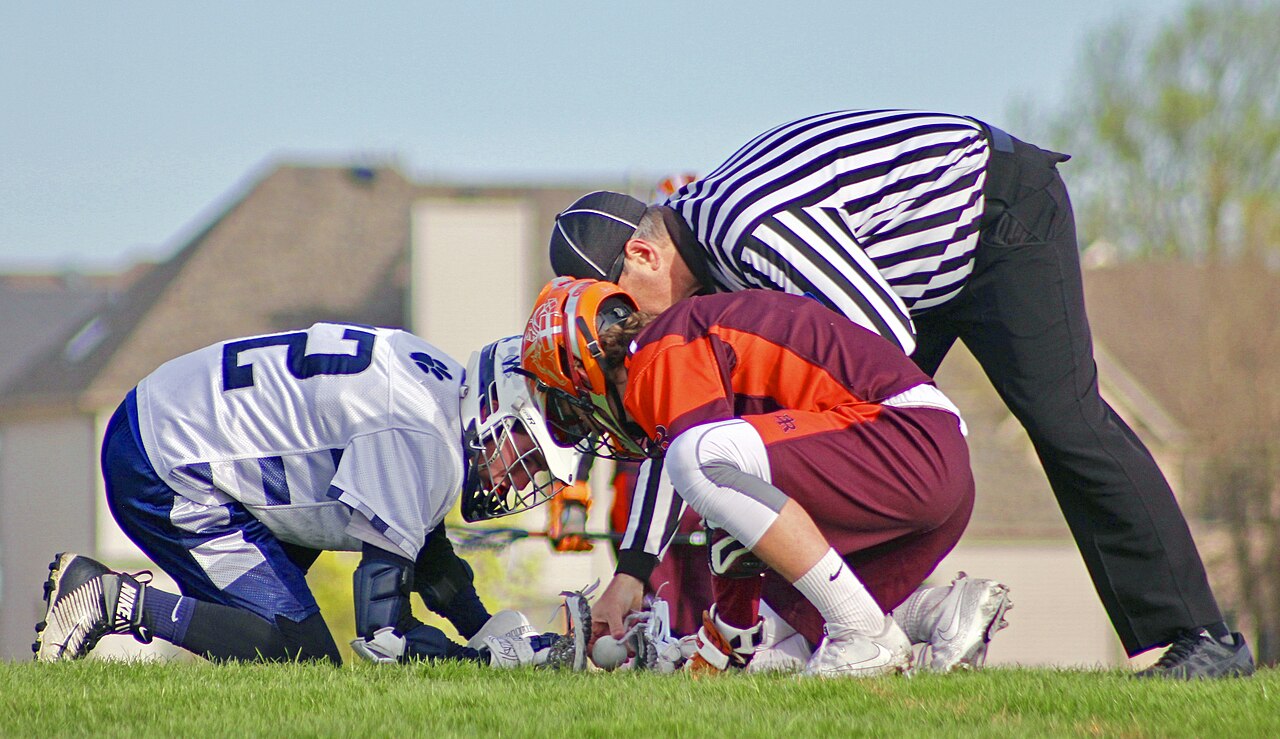
For 2027 the NFHS approved 16 boys lacrosse changes. The biggest: state associations may adopt a 70-second shot clock (4-13); the 10-second count is gone, replaced by 20 seconds to get the ball across the center line (4-14, 4-15); penalty, crease, defensive and goal-area lines are now required, or the home team is charged with illegal procedure (1-2-1); a helmet counts as lost once the chinstrap is off the chin, and play stops right away (4-24-8); a player who leaves for an injury or a lost helmet and comes back too early is a substitution violation, and an attacking-team goal is disallowed (4-9-2p, 4-21-1); faceoff players must go down together with no knee down before the whistle (4-3-3b); and a new rule puts the host or site administrator in charge of fields and equipment (1-13). Whether New York uses the shot clock is a NYSPHSAA decision, so check with your section.
Who these changes reach on Long Island
Long Island is one of the deepest boys lacrosse regions in the country, and almost every level of the game here borrows the NFHS book. High school programs in Section VIII (Nassau) and Section XI (Suffolk) play under NFHS rules as adopted and modified by NYSPHSAA. Their officials learn the changes through their own associations and preseason meetings.
The wider group is everyone else who writes “NFHS rules” on a flyer: middle school and JV schedules, town recreation leagues, travel and club programs, preseason scrimmage days, summer showcases and the multi-field tournaments that run on high school turf from June into August. Many of those events add their own tweaks, such as running time, shorter halves or no overtime, and then assume the rest of the book takes care of itself. In 2027 several changes land directly on the host, not on the players. If you run a field, you are now named in the rule book.
The 2027 changes, rule by rule
The NFHS Boys Lacrosse Rules Committee recommended the changes at its July 19–21, 2026 meeting in Indianapolis, and they were approved by the NFHS Board of Directors. Grouped roughly in the order a host or coach will run into them on game day, here they are.
| Rule | What changed | Who it lands on |
|---|---|---|
| 1-2-1 | The penalty, crease, defensive and goal-area lines are required. If they are missing, the home team is charged with illegal procedure. A contrasting-color center line is now allowed. | Hosts, athletic directors, field crews |
| 1-5 | Starting in 2029, game balls must be fluorescent green or yellow. | Hosts and programs buying balls |
| 1-13 (new) | The host or site administration is responsible for the playing field and its equipment. If no site administrator is present, the home head coach takes on that role. | Hosts, home coaches, tournament directors |
| 2-3-2, 2-3-3 | All coaches must be courteous to officials, and the head coach must help control spectators when an official asks. | Coaching staffs |
| 2-10-2c | Ball retrievers may not stand along the end line while the ball is in play. | Hosts, ball-kid volunteers |
| 4-1-1 (new) | During warm-ups, a five-yard zone on each side of the center line is reserved for the officials. | Both teams during pregame |
| 4-2-1 | The captains’ meeting with the officials happens 10 to 15 minutes before the game. | Captains, head coaches |
| 4-3-3b | Faceoff players go down together, and neither may have a knee on the ground before the whistle. | Faceoff specialists, officials |
| 4-7, 6-12-2, 6-12-3 | A ball stuck in a player’s uniform, equipment or crosse is a technical foul (withholding), except a goalkeeper in the crease. | Players, officials |
| 4-9-2g | A goal is disallowed if the scorer loses any part of a broken crosse on the play. | Officials, scorers |
| 4-9-2p (new), 4-21-1 | A player who left the game for an injury or a dislodged helmet and comes back before the next dead ball commits a substitution violation; if it’s the attacking team, the goal is disallowed. | Coaches, the table, officials |
| 4-13 | State associations may adopt a 70-second shot clock. | State associations, hosts, timers |
| 4-14, 4-15, 6-5-2r, 6-5-2s | The 10-second count in the defensive half is eliminated. A team has 20 seconds to get the ball across the center line, and then the over-and-back rules apply. | Coaches, officials, timers |
| 4-24-8 | A helmet is lost when the chinstrap is no longer on the chin. Play is suspended immediately, whether the ball is live or dead. | Players, equipment managers, officials |
| 6-5-2y | If an opponent’s illegal contact caused the helmet to come off, the player who lost it is not charged with illegal procedure. | Officials, coaches |
Source: NFHS boys lacrosse rules page and 2027 rule-change summary, nfhs.org. Rule numbers are the NFHS references; your state’s adoption and any modifications control in school games.
The shot clock: allowed, not automatic
The 70-second shot clock is the change people will talk about, and it’s worth being precise about what the NFHS did. Rule 4-13 is a state-adoption rule. The NFHS wrote the rule so a state association that wants a shot clock has a national standard to use; it did not put a shot clock into every high school game. Under the NFHS description, the clock starts when a team clears its defensive half or gains possession in its offensive half. The NFHS also says that when 60 seconds remain, the ball must be in the offensive half or possession goes to the other team.
New York is part of the story. The NFHS credited “two years of data collection and successful implementation by the New York State Public High School Athletic Association as an experiment” in its announcement, a line attributed to Lindsey Atkinson, NFHS director of sports. That tells you New York schools have already played with a shot clock under an experiment. It does not tell you exactly how NYSPHSAA will run the 2027 season, which levels it applies to, or how sections will handle visible clocks. Those are NYSPHSAA and section decisions, and we won’t guess at them. If you are a Nassau or Suffolk program, your athletic director and your officials’ association will have the final word.
What a shot clock means for a host
- Someone has to run it. A shot clock is a second clock with its own operator, separate from the game clock. At school sites that is usually a trained adult at the table. At a club or summer tournament it’s the job that gets forgotten.
- Everyone has to see it. Decide whether you have visible clocks, a handheld display, or an on-field timer calling it out, and tell the officials and both coaches before the game.
- Your rules sheet has to say so. If you run a non-school event, write down whether you are using a shot clock at all. “NFHS rules” alone is now ambiguous, because the NFHS book allows it but doesn’t require it.
Need officials who already know the 2027 book?
School games, club schedules, preseason scrimmages and summer tournaments across Nassau and Suffolk. Tell us the fields, the format and the dates, and we’ll tell you plainly what we can staff.
Request lacrosse officials →No more 10-second count: 20 seconds to cross
For years, a boys team that gained possession in its defensive half had 20 seconds to clear the ball past the center line, and then 10 more seconds to get it into the attack box. Starting in 2027, the NFHS has eliminated that second 10-second count. A team has 20 seconds to get the ball across the center line, and after that the over-and-back rules govern. The related illegal-procedure references (6-5-2r and 6-5-2s) were changed to match.
Two practical effects for Long Island games. First, officials will stop giving the familiar visible count as the offense approaches the box, which can confuse younger players and parents who learned the old rule; coaches should go over it in preseason. Second, events that do adopt a shot clock now have one clean structure: get across in 20, then the shot clock carries the rest. If you run youth games with modified rules, decide whether you keep any count at all and put it in writing.
Field lines and the new host rule
Two changes put the host on the hook in a way the book didn’t before.
Required lines (1-2-1). The penalty area, crease, defensive area and goal-area lines are now required. If they aren’t on the field, the home team is charged with illegal procedure. That matters most on multi-sport turf, where lacrosse lines often share the field with soccer, field hockey and football markings, and on grass fields lined by volunteers. A contrasting color for the center line is now allowed, which helps on a busy turf field. Before the first home game, walk the field with your lining diagram and fix gaps; don’t leave it for the officials to find at the pregame check.
Host and site administration (1-13). The new rule makes the host or site administration responsible for the playing field and its equipment. If there is no site administrator present, the home team’s head coach takes that role. For tournaments with several fields running at once, name a site administrator for each field or block of fields, give that person’s name and phone to the officials, and make sure they know they own goals, nets, lines and any shot-clock equipment.
The related sideline changes fit the same theme. Ball retrievers can’t stand along the end line while the ball is live (2-10-2c), so brief your volunteer ball kids on where they may stand. During warm-ups, officials get a five-yard zone on each side of the center line (4-1-1), so teams warming up toward midfield need to give them that space. And the captains’ meeting now happens 10 to 15 minutes before the game (4-2-1), which should be built into your field schedule if games run back to back.
Host checklist for the first 2027 game: lining diagram checked against the required lines; a named site administrator for each field; ball-retriever positions briefed; officials’ warm-up zone left clear; captains’ meeting time built into the schedule; shot-clock plan (yes or no, who runs it) written down; and enough game balls, with a note that from 2029 they must be fluorescent green or yellow.
Helmets, injuries and early returns
The 2027 points of emphasis put player safety and properly worn equipment first, and the rule changes follow suit.
When a helmet is lost (4-24-8). A helmet now counts as lost as soon as the chinstrap is no longer on the chin, and play is suspended immediately whether the ball is live or dead. Coaches should check chinstraps in practice, not on the field at the faceoff. If an opponent’s illegal contact caused the helmet to come off, the player who lost it isn’t charged with illegal procedure (6-5-2y).
Coming back too early (4-9-2p, 4-21-1). A player who leaves because of an injury or a dislodged helmet and returns before the next dead ball commits a substitution violation. If the attacking team does it, a goal scored on that possession is disallowed. On a busy bench, this is an assistant coach’s job: someone needs to track who must sit and when they may return. It also matters for your table crew, who may be asked when the ball was last dead.
Broken sticks and stuck balls. A goal doesn’t count if the scorer loses any part of a broken crosse (4-9-2g). And a ball stuck in a uniform, equipment or crosse is now a technical foul for withholding (4-7, 6-12-2, 6-12-3), except for a goalkeeper in the crease. Officials also listed a second flag down and the NFHS Authenticating Mark on game balls as 2027 points of emphasis.
Faceoffs and coach conduct
The faceoff wording in 4-3-3b now says both players go down together and neither may have a knee on the ground before the whistle. Faceoff specialists who are used to dropping early or setting a knee for leverage will need to adjust. It’s worth having your faceoff coach review the new language with players before the first scrimmage.
Rules 2-3-2 and 2-3-3 now require all coaches, not only the head coach, to be courteous to officials, and require the head coach to help control spectators when an official asks. For Long Island events with big crowds and close sideline seating, that is a useful tool: decide in advance who on your staff or event team handles a crowd issue so the head coach can respond quickly when asked.
What this means for club, youth and summer events
Club and recreation programs don’t have to follow NFHS rule changes unless their own rules adopt the NFHS book. Many do. If your league or tournament says “NFHS rules,” the 2027 changes apply unless you list exceptions. The cleanest way to avoid a sideline argument is a one-page rules sheet that answers:
- Shot clock: yes or no, how long, and who runs it.
- The 20-second cross: are you using it, or a modified version for younger divisions?
- Running time, half length, overtime format and timeouts.
- Who is the site administrator on each field under Rule 1-13.
- Any equipment exceptions for younger players (sticks, balls, pinnies).
Send that sheet with your officiating request. Officials can work almost any reasonable modification, but they need to know it before the game, not at the captains’ meeting. If you run sixes or box games alongside field games, note those separately, since they use different rule sets.
Get your spring and summer lacrosse covered
High school, club, sixes and box games across Long Island. Send your dates, fields and rules sheet, and we’ll confirm what we can staff, including table help.
Request officials for your games →Frequently asked questions
Sixteen changes. The main ones: a state-adoption 70-second shot clock (4-13); the 10-second count eliminated in favor of 20 seconds to cross the center line (4-14, 4-15); required penalty, crease, defensive and goal-area lines (1-2-1); a new host or site administration rule (1-13); a helmet lost once the chinstrap is off the chin (4-24-8); a substitution violation for early returns after an injury or lost helmet (4-9-2p, 4-21-1); new faceoff wording (4-3-3b); and fluorescent green or yellow balls required from 2029 (1-5).
That’s up to NYSPHSAA, not the NFHS. The NFHS rule lets states adopt a 70-second shot clock, and it credited NYSPHSAA’s two-year experiment when it approved the rule. Check with your athletic director, Section VIII (Nassau) or Section XI (Suffolk) for how it will apply to your level.
Yes, under the 2027 NFHS rules. A team has 20 seconds to get the ball across the center line, and then the over-and-back rules apply. There is no separate 10-second count to get into the attack box.
Under Rule 1-2-1 the penalty, crease, defensive and goal-area lines are required, and if they’re missing the home team is charged with illegal procedure. Check your field against the lining diagram before the first home game.
Under Rule 4-24-8, as soon as the chinstrap is no longer on the chin. Play is suspended immediately whether the ball is live or dead. If an opponent’s illegal contact knocked it off, the player isn’t charged with illegal procedure.
Only if their rules adopt the NFHS book. If your event says “NFHS rules,” the new rules apply unless you list exceptions, and because the shot clock is optional you should say whether you use it. Send your rules sheet with your officiating request.