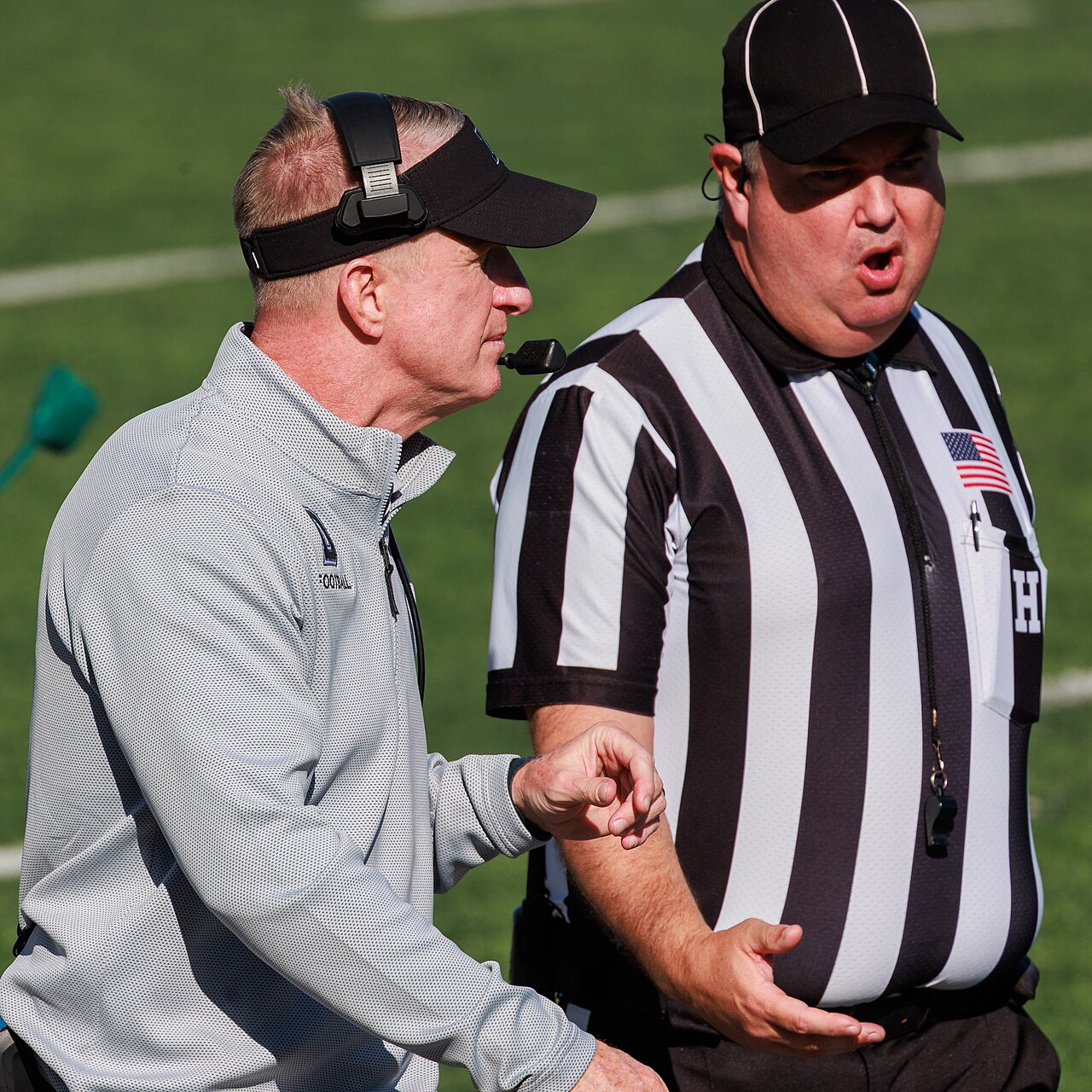
Send a short, factual written complaint to whoever runs the game: the league president or referee coordinator for rec and travel leagues, the athletic director for school games, or the tournament director at an event. Don't go to the official directly. Know the limit going in: most rule books say judgment calls are final and can't be protested. Little League Rule 4.19 says so in plain words, and the soccer Laws of the Game say the referee's decisions on facts connected with play are final. What a complaint can change is who officiates your next games, whether an official gets feedback or training, and whether a misapplied rule is reviewed.
First, decide what you actually have: a complaint or a protest
These are two different things, and mixing them up is the most common reason a complaint goes nowhere.
A protest asks the league to review or overturn something that happened in a game. Leagues that allow protests usually limit them to rules, not judgment. Little League's Rule 4.19 is a clear example: a protest is considered only when it is based on the violation or interpretation of a playing rule, the use of an ineligible pitcher, or the use of an ineligible player. It states that no protest will be considered on a decision involving an umpire's judgment. The manager has to tell the umpire on the field, before the next play, that the game is being played under protest, and then submit it in writing to the local league president within 24 hours. Miss those steps and the protest generally fails, however right you were.
Soccer works the same way at the top level. Law 5 of the IFAB Laws of the Game, which US Soccer-affiliated club and adult soccer is played under (high school soccer uses NFHS rules), says the referee's decisions regarding facts connected with play, including whether a goal is scored and the result of the match, are final.
A complaint is about the official's performance or conduct over a game or a pattern of games: missed fouls that put kids at risk, an official who showed up late or not at all, rude language toward players, a referee who did not seem to know the rules for your age group. A complaint does not change a score. It can change what happens next.
| What happened | What it is | Can it change the result? |
|---|---|---|
| "That was clearly offside" / "That was a foul" | Judgment call | Almost never. Raise it as feedback, if at all. |
| The ump applied the wrong pitch-count or substitution rule | Rule interpretation | Possibly, if your league allows protests and you follow its steps on the spot. |
| The other team used an ineligible player | Eligibility | Possibly, under the league's protest rules. |
| Official was late, left early or never showed | Service problem | No, but it is the easiest complaint to act on. |
| Official swore at or belittled players | Conduct | No, but it should be reported promptly. |
| Fights, threats, or someone touched an official | Safety / possible crime | Handled by the league and, where needed, police. |
Who to send it to on Long Island
Officials rarely work for the team that is unhappy with them. They are assigned by someone, and that someone is who needs to hear about it. Going around the chain usually slows things down.
Town rec, PAL, CYO and travel club leagues
Send it to the league president, commissioner or referee coordinator, using whatever contact the league lists in its handbook or registration site. Many leagues get their officials from an assignor, an officials' association or a booking service; the league is the customer, so it is the league's job to pass the complaint along. Coaches should send it rather than parents. One message from the coach carries more weight than ten from the sideline, and many leagues' codes of conduct route parent concerns through the coach anyway.
Little League
Rule questions go through Rule 4.19 as described above: manager to the umpire on the field, then in writing to the league president within 24 hours. Note 1 to that rule says matters such as field decorum and the actions of league personnel or spectators are not protests; they go to the league's board of directors. Complaints about an umpire's conduct or reliability belong there too, usually through the league's umpire-in-chief.
School games
For middle school, JV and varsity games, go to your school's athletic director. Officials for interscholastic games are assigned through the section's process, and the athletic director is the person who can raise a concern through it. Parents should start with the coach, who will take it to the AD.
Tournaments and showcases
Find the tournament director or field marshal at the event, ideally between games and not in the middle of one. Tournaments move fast; a complaint delivered at 5 p.m. on Sunday after the final is far less useful than a calm word at noon, when the director can still change crew assignments for your next game.
Adult leagues
Captains go to the league operator. Adult leagues are usually run as a business, and the operator has every reason to fix a problem that costs it teams next season.
Run a league and keep getting complaints?
If the real issue is no-shows or thin coverage, we can fill games with certified officials across Nassau and Suffolk.
Request a referee →How to write a referee complaint that gets read
The people who handle complaints read a lot of angry email. The ones that lead to action look like reports, not rants. Keep it to one page.
- The basics: date, start time, field or gym address, the two teams, age group and division.
- Who: the official's name if you know it, or their position (center referee, plate umpire, the referee on the scorer's side). Do not guess at names.
- What happened: two to four specific moments, each with an approximate game time and what you saw. "About 12 minutes into the second half, a player went down after a hit from behind and play continued" is useful. "The ref was terrible all game" is not.
- Why it matters: safety, a rule that was applied wrongly, or a service failure such as a late arrival or no-show.
- Evidence: if you have video, say so and give the timestamps. Don't post it online first.
- What you are asking for: a review, a rules clarification for next time, a different crew for your rematch, or simply that the assignor knows.
Wait until you have cooled down, but send it while the details are fresh, usually the next morning. If your league sets a deadline, as Little League does for protests, that deadline wins.
What to leave out
Leave out insults, guesses about the official's motives, and anything about their age, looks or background. Leave out the scoreboard: "we lost because of the ref" reads as sour grapes even when it is partly true. Don't copy the whole team's parent group. And don't name the official on social media. It rarely helps, can create problems for your league, and it is one of the reasons officials quit, which makes next season's coverage worse for everyone.
What not to do on the day
The worst time to complain is the minute the game ends. Officials usually leave the field quickly after a game, and a coach or parent following them to the parking lot is more likely to end up named in a report than to get an apology. If a coach needs a rules answer during the game, most sports allow a respectful question at a stoppage; ask once, accept the answer, and write it down.
If things have already escalated, the official may have ejected someone. Our guide to whether a referee can eject a parent explains how that works. And if anyone threatens or touches an official, it stops being a complaint issue. For what the law says, see assault on a referee under New York law.
What a fair outcome looks like
Set realistic expectations. In most cases you will get an acknowledgment and a short reply. Leagues and assignors generally do not share discipline decisions about an individual official with the teams involved, so "we've reviewed it and passed it to the assignor" may be all you hear. That does not mean nothing happened.
Outcomes that are fair and common include feedback or a mentor for a newer official; a rules clarification sent to all officials working your division; a note so that official is not assigned to your team's games for a while; and, for repeated no-shows or late arrivals, a change in who the league books. A result being overturned on a judgment call is not a realistic outcome under most rule books.
For league coordinators: build a process before you need one
Leagues that handle complaints well usually have the same few things in place, and none of them cost much:
- One contact. A single email address or form for officiating concerns, listed in the coaches' handbook.
- A simple form. The fields in the list above, so every report arrives in the same shape.
- Coaches only. Parents go through the coach. It cuts volume and keeps the tone civil.
- A response window. Tell coaches when they will hear back, then do it.
- Pattern tracking. One complaint about a judgment call means little. Three about the same official arriving late is a supply problem.
That last point is where many Long Island leagues end up. When the complaints are mostly about officials not showing up, showing up late, or being stretched across too many games, the fix is coverage, not discipline. Our guides on switching referee services mid-season and what to look for when hiring a referee cover how to make that change without losing games.
If you book officials through EmergencyRefs and have a concern about one of our officials, send it to us with the details above so we can follow up. If you are a league that needs reliable coverage after a referee cancels, that is exactly what we do.
Need an official for this weekend?
Send the sport, date, field and age group. We'll call back to confirm coverage and quote it.
Request a referee →Frequently asked questions
Almost never. Most rule books say the official's judgment is final. Little League Rule 4.19 says no protest will be considered on a decision involving an umpire's judgment, and the soccer Laws of the Game (Law 5) say the referee's decisions on facts connected with play are final. A protest can succeed when a rule was misapplied or an ineligible player was used, and only if it is filed the way the league's rules require.
Start with the league, not the official. That usually means the league president, commissioner or referee coordinator. If the league books officials through an assignor or a referee service, the league passes the complaint on. For school games, go to your school's athletic director. At a tournament, go to the tournament director on site.
Wait until you are calm, then send it while details are fresh, usually the next day. Some leagues set deadlines. Little League requires a protest to be raised with the umpire on the field first and then submitted in writing to the local league president within 24 hours. Check your league's bylaws or handbook.
No. Approaching an official after the game rarely fixes anything and can turn into a conduct problem for the team. Send concerns to the coach or league contact, who can raise it through the proper channel. Threatening or striking a sports official in New York can be a crime; see our guide on assault on a referee.
The date, time, field or gym, the teams and age group, the official's name or number if known, and specific moments described factually with approximate game times. Add what you are asking for, such as a review or a different crew next time. Leave out insults and opinions about the official's character.
It depends on the league. Commonly, someone reviews the report, talks to the official or assignor, and decides whether the issue is a rules question, a training need, or a scheduling change. Do not expect to be told about discipline of an individual official, and do not expect a result to change over a judgment call.
Sources: Little League, "Local League Protest Committee" (Rule 4.19 summary) and the Rule 4.19 text as reproduced by local leagues; Little League, "Hey, Blue! Protesting Unsportsmanlike Conduct"; The IFAB, Laws of the Game, Law 5: The Referee (5.2 Decisions of the referee). All checked November 10, 2026. Individual leagues set their own complaint and protest procedures; check your league's bylaws or handbook.