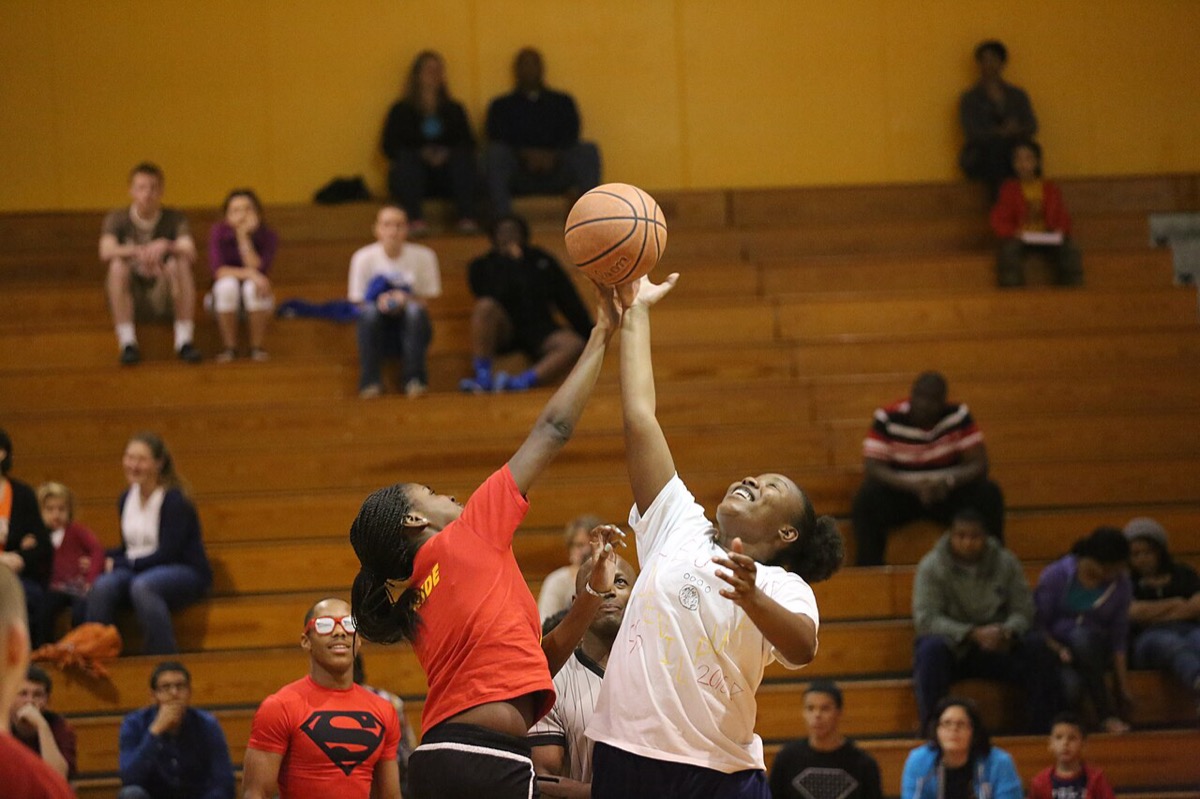
For a faculty vs. student basketball game on Long Island, book one certified referee for a short running-clock format or two for a full-court, stopped-clock game in a full gym, and put a scorekeeper and timekeeper at the table. Write the house rules on one page (game length, clock, contact limits, free throws, substitutions) and give it to the referee and both captains before tip-off. Check whether your district's facility-use office wants a certificate of insurance. Send the date, gym address, format and rules sheet with your request; we quote each event and do not publish a rate card.
This guide is for the athletic director, PTA chair, class advisor or student-council officer who has a date on the calendar, a gym reserved and a flyer half-designed, and now needs someone to actually run the game. It is narrower than our guide to corporate and charity event referees, which covers field days, kickball brackets and company leagues. If you are looking for regular season coverage for a league, start with our Long Island basketball referees page instead.
Why a fundraiser game still needs a real referee
A faculty vs. student game is not an interscholastic contest. It is not on your section's schedule, no league assignor is sending a crew, and nobody outside the building is checking who blows the whistle. That freedom is why schools default to a gym teacher or an assistant coach with a borrowed whistle. It usually works until the third quarter.
Three things tend to go wrong with a volunteer official at these games:
- The conflict is obvious to everyone. A teacher calling fouls on colleagues and on students they grade the next morning is in a no-win spot. A charge call against the principal becomes a story; a non-call on a senior becomes a different one.
- The physical mismatch is real. Varsity players are fast and fit. Some faculty are former college athletes; others have not sprinted since their own senior year. Someone has to decide in real time whether contact is fun or dangerous, and that judgment is the referee's actual job here.
- The crowd is louder than a regular-season game. A student section that came to see teachers lose is a different audience from parents at a JV game. An official used to managing a bench and a crowd keeps the tone friendly without losing the game.
A neutral, certified official solves all three. They have no grades to give and no colleagues to face on Monday, they enforce the contact rules you set, and they keep the clock and the game moving so the event ends when the custodian expects it to.
The injury math nobody puts on the flyer
The single most common way these nights go sideways is an adult getting hurt, and the injury people worry about is not an ankle sprain. It is the Achilles tendon. The American Academy of Orthopaedic Surgeons has noted that Achilles tears affect roughly 30,000 Americans a year, primarily recreational athletes between 30 and 49, the exact age band of a typical faculty roster. A systematic review of the research on Achilles ruptures in basketball cites a U.S. study of 406 cases in which basketball accounted for 32% of all ruptures and 48% of the sports-related ones. Sudden pushes off, jumps and cutting, the moves a teacher makes chasing a fast break, are the classic mechanism.
None of that means you should cancel the game. It means the format should be built for the people playing it:
- Schedule a real warm-up window for the faculty team, not a two-minute layup line after the national anthem.
- Use a running clock and shorter periods so nobody plays forty straight minutes.
- Limit full-court pressure. A press forces exactly the sprint-and-stop movements that strain tendons.
- Set liberal substitution rules and encourage the faculty bench to rotate.
- Know where the building's AED is and who on site is trained to use it, and tell the referee during check-in.
A referee cannot prevent an injury, and we will not pretend otherwise. What the official can do is enforce the format you chose and stop play quickly when someone goes down.
Set the house rules before tip-off
High school basketball under NFHS rules uses four eight-minute quarters with a stopped clock, which in a packed gym with timeouts and free throws can stretch close to two hours. Most fundraiser organizers want something faster and friendlier. The table below lists common choices; it is a menu, not a recommendation, and the right mix depends on your crowd and your schedule.
| Rule area | Common fundraiser choice | Why organizers pick it |
|---|---|---|
| Game length | Four shortened quarters or two halves | Keeps the event inside the gym rental window and the faculty fresh |
| Clock | Running clock, stopped only in the final minutes | Fewer stoppages; predictable end time |
| Defense | No full-court press; man or zone in the half court only | Reduces sprinting and mismatched contact |
| Fouls | No foul-outs, or a high personal-foul limit | Nobody spends the fundraiser on the bench |
| Free throws | One shot worth two, or shoot only in the final minutes | Speeds up the game without ignoring fouls |
| Substitutions | On the fly or at any dead ball | Lets the faculty rotate often |
| Contact and dunks | Written limits on contact; decide on dunks in advance | Prevents the play that turns a fun night into an incident report |
Write it down, then hand it out
Officials enforce what is written. If the rules sheet says "no full-court press until the final two minutes," the referee can call it. If the rule only lived in a hallway conversation between two advisors, the referee will apply standard NFHS rules and somebody will be surprised. One page is enough. Give it to the referee, both captains and the scorer's table, and read the key points over the PA before tip-off so the crowd knows what to expect.
Plan the gimmicks with the referee, not around them
Halftime half-court shot contests, a teacher wearing a costume, a mascot "technical foul," a student guest coach: these are what sell tickets. Tell the official ahead of time which bits are scripted. A referee who knows a staged technical is coming will play along; one who does not may treat it as a real one, or stop the game to sort out what happened.
Faculty vs. student game on the calendar?
Send the date, gym, format and your rules sheet. We'll confirm what we can cover and quote it.
Request a referee →One referee or two, and who sits at the table
For a half-court-heavy, running-clock game with friendly rules, one experienced official is usually enough. Ask for two when any of these apply: the game is full-court and competitive, the clock stops on every whistle, the gym is expected to be full, or the student team includes varsity players who will push the pace. Two officials split the floor, see more of the contact, and give each other cover when the crowd decides a call was wrong.
The table matters more than people expect. A running clock still has to be started, stopped in the final minutes and reset between periods; the score has to be right when the final buzzer sounds and the student newspaper takes a photo of the board. Volunteer students at the table are fine for the scoreboard if someone trained is supervising, but the cleanest setup is a dedicated scorekeeper and timekeeper. Our page on scorekeepers and timekeepers for hire explains what a table crew does and how it is staffed alongside a referee.
The paperwork: facility use and insurance
Even when the game is in your own building, it may go through the district's facility-use process, especially if it is an evening event open to the public or run by a PTA or booster club rather than the school itself. Facility-use offices on Long Island increasingly ask outside vendors, including officials, for a certificate of insurance naming the district as an additional insured. That request comes from the facility, not from the referee's certification.
EmergencyRefs carries general liability insurance and can issue a certificate on request. The fastest way to avoid a last-minute scramble is to ask the facility-use office for its exact wording now and include it with your booking. Our guide to referee insurance and certificates of insurance explains what the certificate covers and what it does not.
Supervision is a separate question. The referee runs the game; the school or the sponsoring organization still runs the event. Chaperones, crowd control, ticketing, the student section and building security stay with the people who booked the gym.
Booking timeline for a school-night game
Faculty vs. student games cluster in a few windows: right before winter break, during spirit weeks, and in late winter around the high school basketball postseason. They also tend to be on weeknights, when the same officials are working league and school games. Earlier is better, but a game is not lost if you are reading this the week of. EmergencyRefs exists for short-notice requests, and if we cannot cover a date we will say so on the callback so you still have time to move it.
The requests we can confirm fastest include:
- date, tip-off time and a realistic end time;
- school name and gym address, plus which door and where officials should park;
- format: halves or quarters, running or stopped clock, one or two games that night (some schools run a faculty vs. student game and an alumni game back to back);
- your rules sheet, or a list of the changes you plan from standard rules;
- whether you want a table crew, or will supply scorekeepers;
- the facility's certificate-of-insurance wording, if any;
- a cell number for the organizer who will be in the gym that night.
Game-night run of show
- Officials' check-in. One adult meets the referee at the door, shows them the locker room or a place to change, and walks them to the table.
- Captains' meeting. Ten minutes before tip-off, the referee meets one faculty captain and one student captain with the rules sheet. This is where "no dunking on the principal" gets agreed out loud.
- Safety walk-through. Point out the AED, the trainer or nurse if one is on site, and the exit the team should use if someone needs to leave the floor.
- Halftime plan. Tell the referee how long halftime will run and what happens during it, so the second half starts on time.
- The end. Decide in advance whether a tie goes to overtime or ends as a tie. Fundraiser crowds usually want a winner; a short overtime period with a running clock is a common answer.
What we won't claim
We do not list schools or districts we "officially serve," and we will not quote a price on this page; we quote each event. We do not promise that every weeknight in a busy stretch can be covered, and we cannot make a mismatched game safe on our own. What we do is put a certified basketball official, and a table crew if you want one, in your gym for the format you chose, once the request is specific enough to assign.
Book a referee for your fundraiser game
Date, gym, format and house rules. We'll call back to confirm coverage and quote it.
Request a referee →Frequently asked questions
Nothing requires one for a fundraiser, but a neutral official changes the night. Teachers refereeing their own colleagues against their own students is a built-in conflict, and the referee is the person who enforces the contact limits you agreed to. A certified official also knows how to manage a clock and a crowd, which a volunteer usually does not.
Most fundraiser games run fine with one referee on a half-speed, running-clock format. If the game is full-court, uses a stopped clock, or the gym will be packed, ask for two. Either way, put a scorekeeper and timekeeper at the table so the referee is not also running the scoreboard.
Yes. Send a one-page rules sheet with the request and hand it to both captains before tip-off. Officials enforce what is written: running clock, no full-court press, no dunks for adults, free-throw shortcuts. If a rule is not on the sheet, expect standard NFHS basketball rules to apply.
EmergencyRefs carries general liability insurance and can issue a certificate of insurance naming the district or school as additional insured. Send the exact wording the facility-use office needs with your request so it is ready before game night.
We quote each event rather than publishing a rate card. Game length, one or two officials, table crew, and the date and time all change the number. The quote you get on the callback is the number to plan around.
Sources: American Academy of Orthopaedic Surgeons, Achilles tear press release (JAAOS review), Jan. 2017; "The Achilles Tendon Rupture in Basketball: Systematic Review of the Present Literature" (PMC, citing Raikin et al.); NFHS basketball rules. Injury information is general and not medical advice.