Most youth and school programs plan cold-weather games around wind chill, not the air temperature. The guideline in the NATA position statement on cold injuries, which many athletic departments copy into their policies: at a wind chill of 30°F and below, be alert to cold injury; at 25°F and below, add protective clothing and rewarming; at 15°F and below, modify activity to limit exposure; at 0°F and below, consider stopping or rescheduling. Snow and frozen ground are separate calls, usually made by whoever controls the field. The referee decides whether the game can be played safely once everyone is there. If a cold or snow call cancels a game we staffed, it is handled like our rainout policy.
Who actually makes the call on a cold or snowy day
Organizers lose time on winter mornings because three different people think the decision belongs to someone else. It helps to separate them before the season starts.
- The field owner. A town parks department, school district or private facility can close a field for snow, ice or a frozen or thawing surface, often to protect the grass as much as the players. If the field is closed, nothing else matters. Know who posts field closures for every site on your schedule and how early they do it.
- The league or tournament director. Your written weather policy decides whether a game goes ahead in marginal cold, whether it is shortened, and how makeups work. This is the call you control.
- The referee. Once the game is on, the official has the authority to delay, suspend or end it if conditions become unsafe: lines disappear under snow, the ball cannot roll, footing turns to ice, or players are showing signs of cold injury. A referee will not overrule a field closure, and should not be asked to make your league’s policy decision on the spot.
When those three are lined up in writing, a 6 a.m. forecast turns into one phone call instead of twenty.
The wind chill guideline most programs use
Wind chill is the “feels like” number the National Weather Service publishes alongside the temperature. It estimates how fast exposed skin cools from the combination of cold air and wind, so it is a better guide to frostbite risk than the thermometer alone. The National Athletic Trainers’ Association’s position statement on environmental cold injuries includes a risk-management guideline based on it, and colleges and high school associations reproduce it in their own cold-weather policies. Nassau Community College’s athletic department, for example, publishes the same four thresholds in its cold environment protocol.
| Wind chill | Guideline (NATA) | What it usually means on game day |
|---|---|---|
| 30°F and below | Be aware of the potential for cold injury and notify appropriate personnel. | Tell coaches and the official in advance; layers allowed under uniforms where rules permit; benches out of the wind if possible. |
| 25°F and below | Provide additional protective clothing, cover exposed skin, and provide opportunities and facilities for rewarming. | Hats and gloves on the sideline; a warm car, building or heated tent for breaks; shorter warmups standing still. |
| 15°F and below | Consider modifying activity to limit exposure or to allow more frequent chances to rewarm. | Shorter halves or periods, extra breaks, fewer games per field per day; decide before the official arrives. |
| 0°F and below | Consider terminating or rescheduling activity. | Most youth programs reschedule. Make the call early enough that nobody drives in. |
Two caveats from the same statement are worth building into your policy. First, conditions should be reassessed continuously, including precipitation; wet clothing in moderate cold can be more dangerous than dry clothing in deep cold. Second, the published wind chill does not include the wind a player creates by running, so a sprinting athlete is exposed to more cooling than the number suggests. Several programs that use these thresholds, including the Missouri high school association’s guidance, also say teams may cancel or alter activity at warmer readings when the situation calls for it, especially for younger children.
❄️ The NWS changed its cold alert names in October 2024. The old Wind Chill Advisory is now a Cold Weather Advisory, and Wind Chill Watches and Warnings became Extreme Cold Watches and Warnings, issued for dangerous cold with or without wind. If your written policy still says “cancel on a Wind Chill Warning,” update the wording so nobody argues about it on a Saturday morning.
Snow, ice and frozen fields are different problems
A cold day and a snowy day can call for different decisions even at the same temperature.
Snow on the field
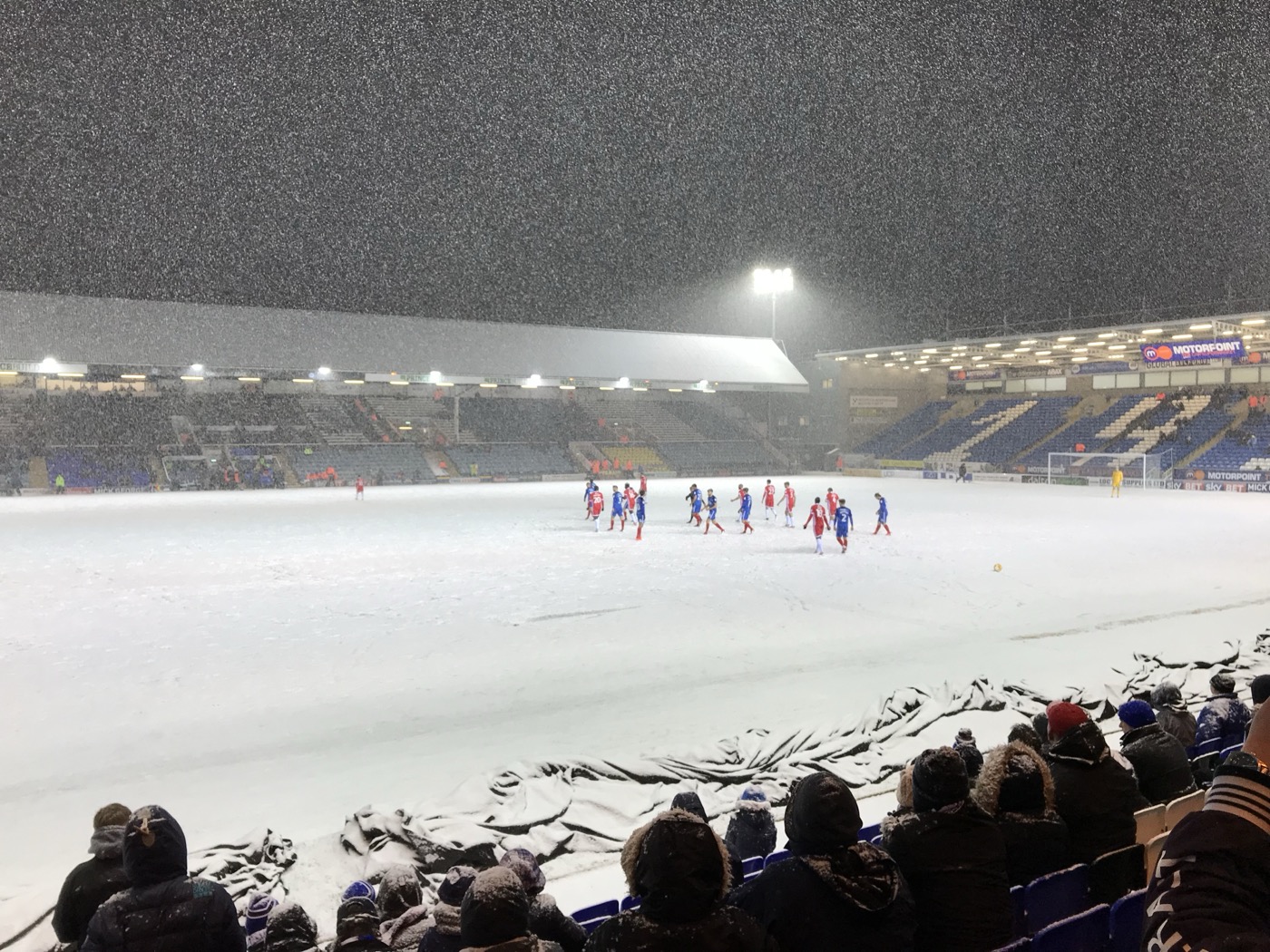
A dusting may be playable on turf and even on grass. Once lines and boundaries disappear, the official cannot call out of bounds, offside lines, the crease or the goal area with any confidence, and the ball stops behaving normally. Clearing a turf field is possible but takes equipment and hours, which most town fields do not have on a Saturday morning. If snow is still falling during a game, visibility and footing can change fast. The photo above shows a professional referee stopping a match for exactly that reason, with full stadium lighting and a grounds crew on hand.
Ice and frozen ground
Frozen natural grass is hard and uneven, closer to a parking lot than a field, and a thaw in the afternoon turns it into mud that tears up the turf. That is why parks departments close grass fields in freeze-thaw weather even when it is not especially cold. Icy parking lots, walkways and bleachers are a hazard for spectators and officials as much as players. Plan the approach to the field, not just the field.
Indoor alternatives
Many Long Island winter programs move indoors for exactly these reasons: gyms, bubbles and indoor turf facilities. If you are planning winter soccer, flag football or lacrosse, our guides to winter indoor soccer referees and indoor facility referees cover what changes when the game comes inside.
Cold-weather game still on?
If the forecast held but your official dropped out, send the date, field, sport, age group and crew size. We take same-day requests across Nassau and Suffolk.
Request a referee →Signs of cold injury officials and coaches should watch for
Officials are often the only adults on the field who see every player for the whole game. A good cold-weather policy tells everyone, including the referee, what to look for and who to tell. The NATA statement describes the main conditions in detail; the short version for game day:
- Frostnip and frostbite. Exposed skin (ears, nose, cheeks, fingers) turning white, gray or waxy, numbness, or a player who cannot feel the ball in their hands. NATA recommends protecting toes, fingers, ears and skin when wind chill reaches the range where frostbite is possible in 30 minutes or less.
- Hypothermia. Intense shivering, clumsiness, slurred speech, confusion or unusual quietness in a child who was fine at kickoff. Wet players and players on the bench cool faster than players who are moving.
- The quiet kid on the bench. Substitutes standing in the wind for long stretches are often colder than anyone on the field. Rotate them, give them blankets or let them warm up in a car or building.
Players showing these signs need to get out of the cold and be rewarmed, and serious symptoms need medical help. Have a plan for both, and make sure it is in your emergency action plan alongside concussion and lightning and heat procedures.
What to put in your written cold-weather policy
A one-page policy that every coach, parent and official has seen does more than any forecast app. It should answer:
- Which number you use. Wind chill from the National Weather Service forecast for the field’s town, checked at a set time.
- The thresholds. Whether you follow the NATA bands above or something stricter for younger age groups.
- When the call is made. A fixed decision time, for example two to three hours before the first game, and a second check for afternoon games.
- Who makes it and how it is announced. One person, one channel: email, text list or app.
- What “modified” means. Shorter periods, extra breaks, running clock, or fewer games per field.
- Clothing rules. What layers, hats and gloves are allowed under your sport’s rules, decided before game day so the official is not refereeing a uniform debate.
- Makeups. Where and when cancelled games are replayed, and who rebooks the officials.
What happens to your referee booking
Cold and snow cancellations are handled the same way as our rainout policy: if the game is called before your official leaves home, there is no charge. If the official is already on site when the game is called off or stopped, a time-based fee applies. The easiest way to avoid that fee is the fixed decision time in your policy: make the call before anyone gets in the car.
The bigger winter problem is usually not the cancelled game but the makeup. A snowed-out Saturday pushes games onto the next weekend, when every other league is doing the same, and officials who were available for the original date may not be free for the new one. Our guide to winter sports referee booking covers how to plan makeup slots, and how to cancel or reschedule a booking walks through the notice we need.
Rescheduling after a snow day?
Send your makeup dates as soon as they are set. We will tell you plainly which games we can cover.
Request officials for makeup games →Frequently asked questions
There is no single legal cutoff in New York. Many programs follow the NATA wind chill guideline: be alert to cold injury at 30°F and below, add protective clothing and rewarming at 25°F and below, modify activity at 15°F and below, and consider stopping or rescheduling at 0°F and below. Leagues may set stricter limits for younger players.
Wind chill. It combines air temperature and wind to estimate how fast exposed skin cools, which is the main frostbite risk. The National Weather Service publishes it in every forecast. Remember that running adds wind the forecast does not include.
Once a game is underway or about to start, the referee can delay, suspend or end it if conditions are unsafe, for example when lines are buried, footing is icy or players show signs of cold injury. Field closures come from the field owner, and the decision to schedule or cancel in advance belongs to the league.
With EmergencyRefs, it works like our rainout policy: no charge if the game is called before your official leaves home, and a time-based fee if the official is already on site when the game is called or stopped.
It depends on your sport's rule book and your league's rules. Many youth leagues allow extra layers in cold weather, but some items, such as hats with hard parts or jewelry, may still be restricted. Put your clothing rules in writing before the season so the official is not deciding on the spot.
Since October 1, 2024, the National Weather Service issues Cold Weather Advisories (formerly Wind Chill Advisories) and Extreme Cold Watches and Warnings for dangerous cold with or without wind. A simple way to use them in a written policy: treat an Extreme Cold Warning for the field's area as a cancellation trigger, and a Cold Weather Advisory as the trigger for your modified-activity rules.
Sources: Cappaert TA et al., “National Athletic Trainers’ Association Position Statement: Environmental Cold Injuries,” Journal of Athletic Training, 2008 (PMC); Nassau Community College Athletics, Cold Environment Protocol; MSHSAA, Cold Weather Guidelines; National Weather Service, revised cold watch, warning and advisory products (October 1, 2024). Checked November 17, 2026. This article is general planning information, not medical advice.